

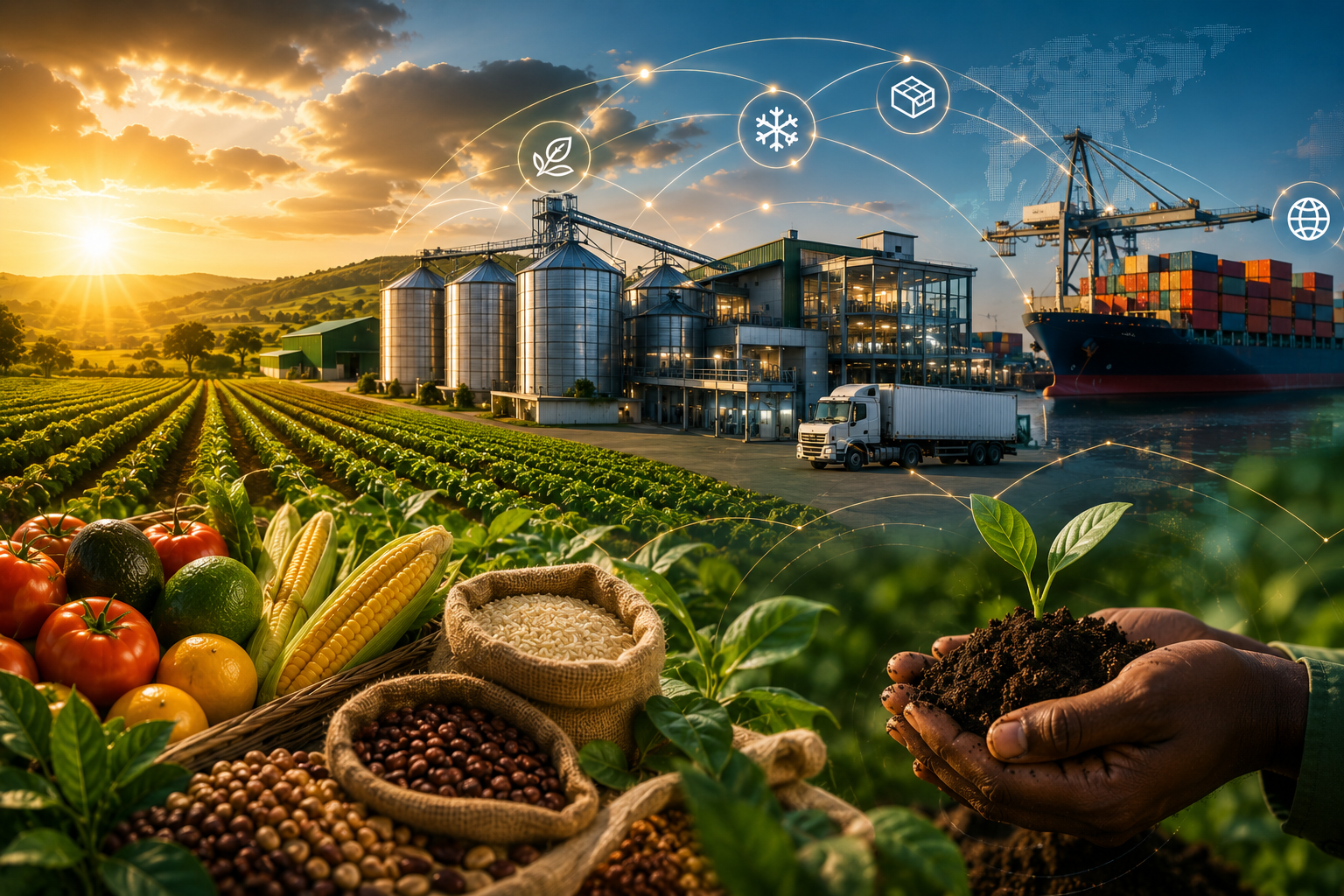
For decades, discussions about African agriculture have focused primarily on production: how to improve yields, strengthen food security and increase farmers’ access to inputs. These priorities remain essential. Yet the debate is gradually shifting, the central question is no longer simply how much food African countries can produce but how much economic value they can retain after the harvest.
Agricultural products rarely reach consumers directly from the farm. Between production and consumption lies an entire industrial ecosystem: aggregation centres, storage facilities, cold chains, processing plants, laboratories, packaging lines, logistics networks and distribution platforms. When these intermediate capabilities remain underdeveloped, farmers receive lower prices, food losses remain high and countries continue to import processed goods that could potentially be manufactured locally.
In 2026, this transition from agriculture to agro-industry has become increasingly visible in Africa’s policy agenda.
The Kampala Comprehensive Africa Agriculture Development Programme Strategy and Action Plan covers the period from 2026 to 2035. Its ambitions are significant: mobilising USD 100 billion in public and private investment, increasing agrifood output by 45%, tripling intra-African trade in agricultural goods and halving post-harvest losses by 2035 [1].
The strategy was formally launched in 2025, but 2026 marks the beginning of its implementation phase. In March, the African Union Commission and AUDA-NEPAD organised a high-level workshop in Yaoundé to help Member States and Regional Economic Communities translate the framework into practical plans. The discussions focused on investment design, execution readiness, governance and the institutional gaps that could hinder delivery [2].
Later that month, a continental consultation in Windhoek examined the indicators that will be used to monitor progress. The emphasis on measurable results is important. Africa’s agricultural transformation will depend not only on policy commitments, but on the ability to turn them into investment-ready projects and functioning value chains [3].
The most significant opportunities may be found in what could be described as the missing middle of African agriculture: the stages between cultivation and final consumption.
A crop can be successfully harvested and still generate limited value if it cannot be stored, processed or transported efficiently. Perishable products require refrigeration. Grains require drying and warehousing. Fruit may need sorting, pulping, bottling or packaging. Dairy and livestock value chains depend on quality controls and temperature-managed logistics. Export markets require traceability and compliance with technical standards.
A concrete example emerged in Zimbabwe in May 2026. With technical support from the Food and Agriculture Organization of the United Nations, the country established a National Post-Harvest and Agro-Processing Technical Working Group. The initiative responded to a clear problem: agricultural production was improving, but substantial value continued to be lost because of weaknesses in storage, cold-chain infrastructure and processing capacity [4].
The example is national, but the challenge is broader. Agro-industrialisation cannot be reduced to the construction of factories alone. Effective value chains require coordinated infrastructure, technical skills, reliable energy, quality systems and access to finance.
Regional integration could further accelerate this transition. In February 2026, the African Continental Free Trade Area Secretariat and AGRA signed a memorandum of understanding intended to fast-track intra-African agricultural trade. The partnership places agriculture at the centre of regional food security, farmer prosperity and local value addition [5].
The underlying logic is straightforward. A processing facility does not necessarily need to serve only the country in which it is located. As regional trade becomes easier, strategically positioned agro-industrial hubs can serve neighbouring markets. A cold-storage platform, packaging line or food-processing plant can become part of a wider regional network.
A practical illustration can be found in the Zimbabwe-Mozambique Agriculture Value Chain and Trade Development Project. In April 2026 the FAO, the two national governments and the Italian Agency for Development Cooperation highlighted the potential of sesame, macadamia and tomato value chains. The project seeks to support the transition from informal trading to competitive, export-oriented agro-industrial activity, while reducing non-tariff barriers and encouraging private-sector investment in aggregation, processing and logistics [6].
This approach is especially relevant for smaller markets. Domestic demand alone may not always justify investment in specialised facilities. Regional integration can improve project economics by expanding the potential customer base and enabling countries to develop complementary industrial capabilities.
Technology and infrastructure alone will not be sufficient. Agro-industrial projects also require financing models adapted to farmers, cooperatives and small and medium-sized enterprises.
In May 2026, Ecobank Group and AGRA announced a strategic partnership focused on sustainable and climate-resilient agricultural growth. The initiative seeks to de-risk agricultural lending through blended finance, risk-sharing mechanisms and tailored financial products for agribusiness SMEs and smallholder farmers [7].
The development of local processing capacity often depends on relatively practical investments: modular production lines, storage facilities, refrigeration systems, packaging equipment, laboratory services and logistics platforms. Yet these projects may struggle to secure financing if they are assessed through conventional lending models without consideration of their specific operating conditions.
European companies can contribute to this transition, but the most effective approach is unlikely to be based on the simple export of machinery.
Selling equipment without local adaptation, training or maintenance may produce limited long-term results. Agro-industrial projects require a more structured model: identifying local partners, assessing demand, selecting appropriate technologies, training operators, developing quality procedures and ensuring that spare parts and technical support remain available after installation.
This creates opportunities for industrial partnerships rather than one-off transactions.
European expertise can be particularly relevant in food processing, packaging, refrigeration, water efficiency, renewable energy, waste valorisation, digital traceability and quality assurance. Many of these technologies already exist. The challenge is to adapt them to the scale, costs and operating conditions of different African markets.
The strongest projects will combine commercial viability with local value creation. This means working with farmers, cooperatives, local enterprises and public institutions rather than treating agricultural raw materials merely as inputs for export.
Africa does not simply need to produce more. It needs to transform more of what it already produces.
The opportunity lies in building the systems behind the harvest: the storage facilities that prevent losses, the energy solutions that power processing, the laboratories that ensure quality, the logistics networks that connect markets and the industrial partnerships that allow locally produced goods to become competitive products.
In 2026, the direction is becoming clearer. The next phase of Africa’s agricultural transformation will extend far beyond the farm.
References
[1] African Union, African Union Launches the CAADP Strategy and Action Plan 2026–2035 and the CAADP Kampala Declaration, 6 May 2025.
https://au.int/en/pressreleases/20250506/au-launches-caadp-strategy-action-plan-2026-2035-caadp-kampala-declaration
[2] African Union, High-Level Dialogue and Workshop on CAADP Kampala Implementation Guidelines and Domestication Tools, 17–19 March 2026.
https://au.int/en/newsevents/20260317/high-level-dialogue-and-workshop-caadp-kampala-implementation-guidelines-and
[3] African Union, African Union Holds Continental Consultation on CAADP Kampala Result Framework and Biennial Review, 27 March 2026.
https://au.int/en/pressreleases/20260327/au-holds-continental-consultation-caadp-kampala-result-framework-and-br
[4] Food and Agriculture Organization of the United Nations, Zimbabwe Establishes a National Platform for a Smarter Post-Harvest Management Architecture, 15 May 2026.
https://www.fao.org/africa/news-stories/news-detail/zimbabwe-establishes-a-national-platform-for-a-smarter-post-harvest-management-architecture/en
[5] AGRA, The AfCFTA Secretariat and AGRA Seal New Partnership to Fast-Track Intra-African Trade and Agricultural Growth, 16 February 2026.
https://agra.org/the-afcfta-secretariat-and-agra-seal-new-partnership-to-fast-track-intra-african-trade-and-agricultural-growth/
[6] Food and Agriculture Organization of the United Nations, FAO and Partners Unpack Bottlenecks and Solutions for Formal Cross-Border Agritrade in Southern Africa, 24 April 2026.
https://www.fao.org/africa/news-stories/news-detail/fao-and-partners-unpacked-bottlenecks-and-solutions-for-formal-cross-border-agritrade-in-southern-africa/en
[7] AGRA, Ecobank Group and AGRA Forge Strategic Partnership to Transform Agricultural Value Chains and Drive Inclusive Growth in Africa, 11 May 2026.
https://agra.org/ecobank-group-and-agra-forge-strategic-partnership-to-transform-agricultural-value-chains-and-drive-inclusive-growth-in-africa/
Looking to Build Stronger Agribusiness Value Chains in Africa?
From agro-processing and cold-chain infrastructure to packaging, quality systems and regional expansion strategies, we help transform promising ideas into locally grounded and investment-ready initiatives.